








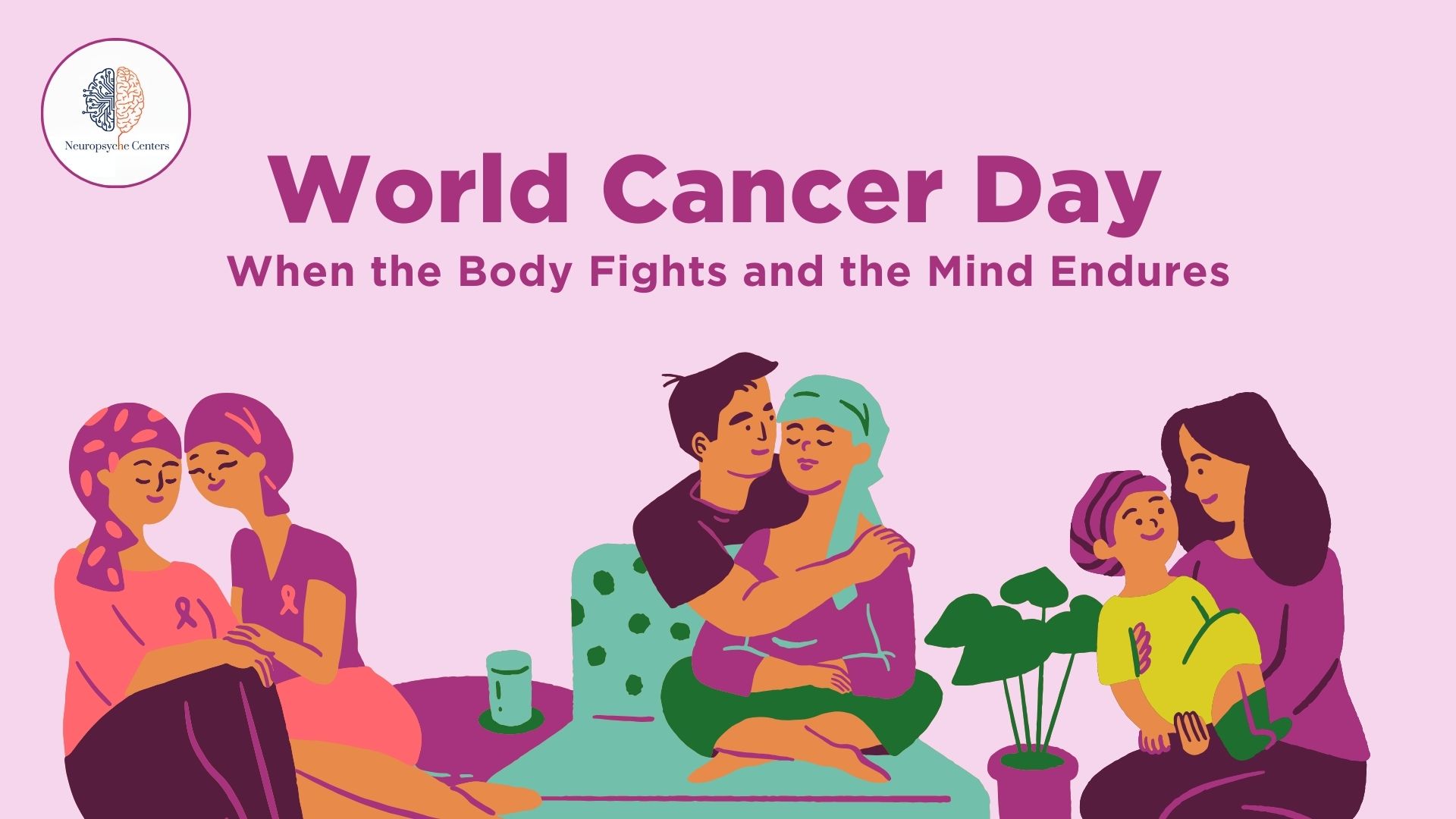
World Cancer Day: When the Body Fights and the Mind Endures
Every year on World Cancer Day (4th February), the world comes together to talk about prevention,
early detection, treatment, and survival. As a mental health professional, I notice something important
every time this day arrives: conversations often focus on the body—cells, scans, chemotherapy,
remission—but the mind quietly carries an equally heavy burden, often without words, without space,
and without acknowledgment.

Cancer is not just a medical diagnosis. It is a psychological event. It enters a person’s life uninvited
and alters identity, relationships, routines, beliefs about the future, and the very meaning of safety and
control. On World Cancer Day, it is essential to speak not only about curing cancer, but also about
caring for the mind that lives through it.
The Moment of Diagnosis: A Psychological Earthquake
The day a person hears the word cancer is rarely remembered for medical details. It is remembered
for the silence that follows.
Patients often describe:
- Feeling numb or detached
- A sudden fear of death
- Racing thoughts about family, finances, and unfinished dreams
- A sense of “this cannot be happening to me
From a psychological lens, this is an acute stress response. The brain shifts into survival mode.
Logical thinking reduces, emotional intensity increases, and the person may oscillate between denial
and panic. This reaction is not weakness—it is the nervous system doing its job in the face of
perceived threat.
Many patients blame themselves for “not being strong enough” at this stage. As professionals, we
must normalize this response. Strength does not mean absence of fear; it means continuing despite
fear.
Cancer and Identity: Who Am I Now?
One of the most overlooked psychological impacts of cancer is identity disruption.

A person may begin to think:
- “I am no longer independent”
- “My body has betrayed me”
- “I am now a burden”
- “People only see me as a patient”
Hair loss, weight changes, scars, fatigue, and dependence on others slowly reshape self-image. For
many individuals, especially women, body image distress can be profound. For men, the loss of the
role of provider or protector may trigger deep feelings of inadequacy and shame.
Cancer does not only attack cells—it challenges the self-concept. Therapy often focuses on helping
patients separate who they are from what they are experiencing. You are not your illness. You are a
person living with an illness.
The Emotional Rollercoaster of Treatment.
Chemotherapy, radiation, surgeries, and long hospital stays bring more than physical side effects.
Emotionally, patients may experience:
- Anxiety before scans and reports (scanxiety)
- Depression due to prolonged fatigue and loss of routine
- Irritability and emotional outbursts
- Guilt for feeling like a burden
- Fear masked as anger or withdrawal
Sleep disturbances and appetite changes further intensify emotional instability. From a clinical
psychology perspective, prolonged treatment can lead to adjustment disorders, clinical depression, or
health anxiety, especially when psychological support is absent.
Yet many patients hear phrases like:
“Stay positive”
“Don’t think negatively”
“Others have it worse”
While well-intentioned, such statements can silence real emotions. Toxic positivity can be as harmful
as hopelessness. Healing requires permission to feel—sad, angry, scared, hopeful—all at once.
The Family’s Invisible Struggle
Cancer never affects just one person. It impacts the entire family system.
- Caregivers—spouses, children, parents—often experience:
- Chronic stress and burnout
- Suppressed emotions to “stay strong”
- Fear of loss they cannot express
- Role strain and exhaustion

Children may show behavioral changes, academic decline, or anxiety without understanding why.
Elderly caregivers may neglect their own health. Families often need psychological intervention as
much as patients do, yet they are rarely included in the treatment plan.
As mental health professionals, we emphasize family counseling and caregiver support, because a
regulated caregiver can provide better emotional containment for the patient.
Cancer Survivorship: The Trauma After Survival
Surviving cancer does not automatically restore mental peace.
Many survivors struggle with:
- Fear of recurrence
- Hypervigilance to bodily sensations
- Difficulty trusting their body again
- Existential questions about purpose and meaning
This is often referred to as post-treatment psychological distress. Some survivors even experience
symptoms similar to post-traumatic stress, including intrusive memories of hospital stays or panic
during follow-up appointments.
Ironically, society expects survivors to feel only gratitude and happiness. When they don’t, they feel
guilty. Psychological care during survivorship is just as crucial as during treatment.
The Power of Psychological Interventions in Cancer Care

Research consistently shows that psychological interventions improve:
- Treatment adherence
- Pain management
- Emotional regulation
- Quality of life
- Overall coping ability
Interventions such as:
- Cognitive Behavioral Therapy (CBT)
- Mindfulness-based stress reduction
- Art therapy and expressive therapies
- Support group therapy
- Dance and movement therapy
help patients reconnect with their bodies in non-threatening ways, process emotions safely, and
regain a sense of control.
Mental health care does not replace medical treatment—it strengthens it.
On World Cancer Day: A Call Beyond Awareness
On this World Cancer Day, let us expand the narrative.
- Let us talk about therapy as openly as chemotherapy
- Let us ask patients how they are feeling, not just how they are doing
- Let us support caregivers without glorifying burnout
- Let us recognize emotional pain as real pain

Cancer care must be integrated care—where oncologists and mental health professionals work
together, where emotional well-being is not an afterthought, and where vulnerability is not mistaken
for weakness.
If you are someone living with cancer, supporting someone with cancer, or surviving after cancer—
your emotional experience is valid.
You do not have to be brave every day.
You do not have to stay positive all the time.
You do not have to carry this alone.
Healing is not only about surviving cancer.
It is also about preserving the humanity of the person living through it.
On this World Cancer Day, let us honor not just the fighters—but the feelers, the grievers, the hopeful,
the exhausted, and the quietly resilient minds behind every diagnosis.
Because treating cancer means treating the whole person—mind, body, and soul.