







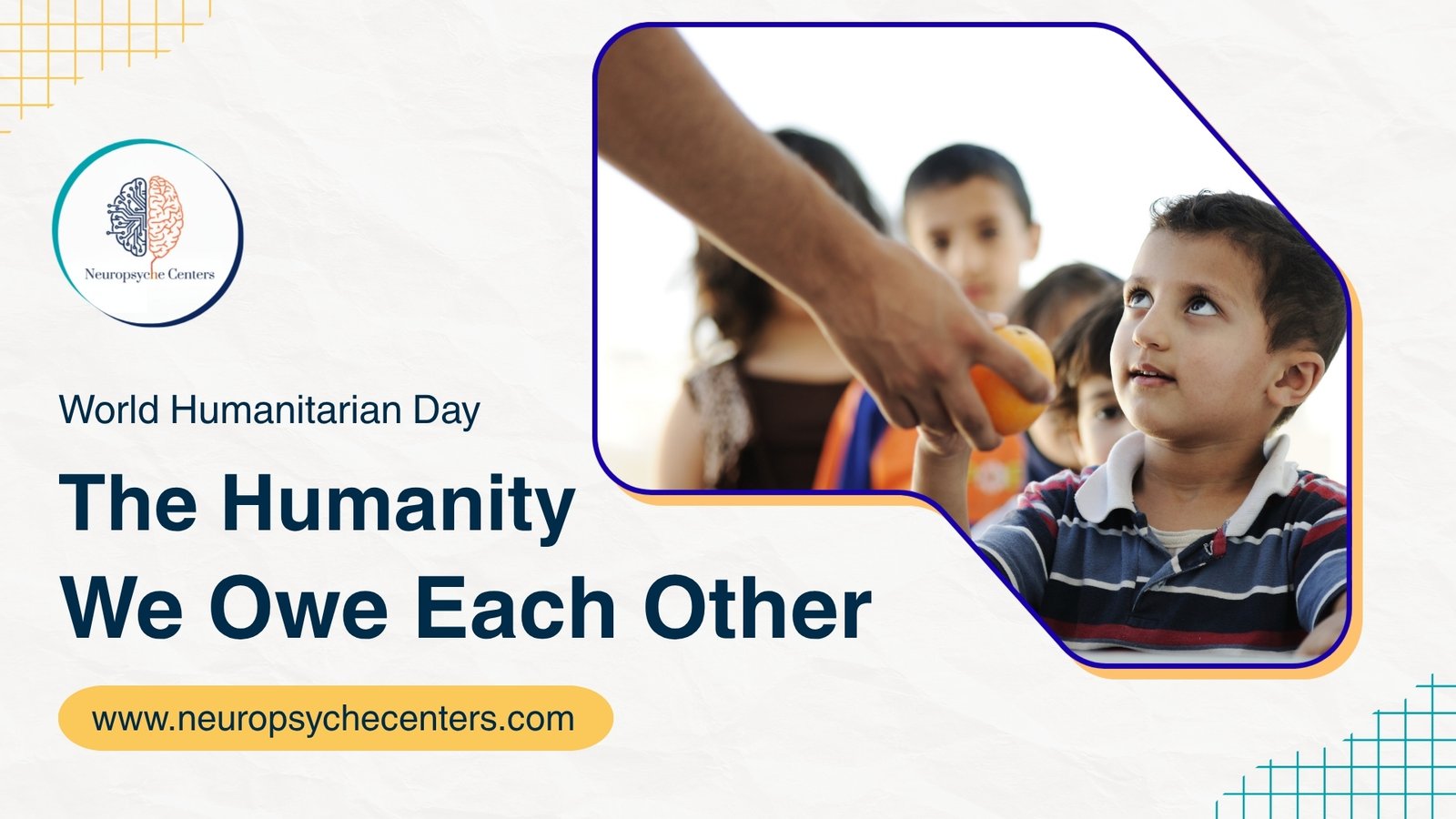
World Humanitarian Day: The Humanity We Owe Each Other
Every year on 19 August, World Humanitarian Day reminds us to look beyond crises, statistics and headlines and remember the people at the heart of them. Humanitarianism is often associated with wars, natural disasters, displacement, poverty and emergency relief, but at its core, it is about something much more universal: the belief that every human being deserves dignity, safety, compassion and care. In a world where people can easily become numbers in a report or faces in a news story, this day asks us to pause and see the person behind the circumstance – the parent trying to keep a family safe, the child struggling to understand a sudden change in life, the individual grieving something they cannot replace, or the person quietly carrying a burden that nobody else can see. This is also where World Humanitarian Day connects deeply with mental health. A person’s wellbeing is shaped not only by what happens inside their mind, but also by the world around them, whether they feel safe, heard, respected, connected and supported. Humanitarian care therefore cannot be limited to providing physical necessities. Food, water, shelter and medical assistance are essential, but so are dignity, emotional safety, human connection and hope. This is why the day reminds us of being human because being human means-
- Recognizing vulnerability rather than judging it
- Offering support without making someone feel weak
- Understanding that needing another person is not a failure.
None of us moves through life completely independently. At different moments, we may be the person offering a hand, the person reaching for one, or simply the person who notices that someone needs one.
When Wellbeing Becomes a Shared Responsibility
World Humanitarian Day also challenges the way we think about health. We often separate physical health from mental health, and individual wellbeing from social wellbeing, when in reality they are deeply connected. A person cannot always heal emotionally simply because their physical needs have been met, just as a community cannot be truly healthy when large numbers of people are living with fear, isolation, discrimination, grief or hopelessness. Holistic health is about the whole human experience- the body, mind, emotions, relationships, environment and sense of belonging. Humanitarian action reflects this understanding because it responds not only to what people need to survive, but also to what they need to rebuild their lives with dignity. It reminds us that mental health is not simply an individual’s responsibility. Telling someone to “be resilient” while ignoring the circumstances that are overwhelming them can place the entire burden of wellbeing on the individual. Sometimes what a person needs is not another lesson in coping, but a safer environment, a supportive community, access to resources, someone willing to listen, or simply the reassurance that they have not been forgotten.
A humanitarian and mentally healthy society therefore try to create conditions where people can experience:
- Safety – because psychological wellbeing becomes difficult when a person constantly feels threatened or uncertain.
- Dignity – because people deserve to be treated as individuals, not defined by their circumstances or difficulties.
- Connection – because supportive relationships can provide belonging and reduce the loneliness that often accompanies hardship.
- Access to support – because emotional distress should have somewhere to go, whether through family, community resources, schools, workplaces or professional mental-health services.
- Hope – not as forced positivity, but as the belief that difficult circumstances can change and that support is possible.
These are not luxuries that become important only after physical needs have been met. They are part of what makes health whole. This is why humanitarian values matter even outside large-scale emergencies. They can shape the way we behave in our homes, schools, workplaces and communities. A student who is struggling may need understanding before advice, a grieving person may need companionship rather than pressure to move on, an exhausted parent may need support rather than criticism and someone experiencing emotional distress may need to know that asking for help does not make them a burden. When compassion becomes part of the environment people live in, wellbeing stops being something individuals have to achieve alone. A healthy society is not one where everyone is strong all the time, it is one where people are allowed to be human and supported when they are not.
Conclusion: Perhaps Humanity Is the Care We Choose to Give
Perhaps the most meaningful way to understand World Humanitarian Day is not to see it as a day that belongs only to humanitarian organizations or moments of global crisis, but as a reminder of the kind of world we participate in creating every day. We may not always be able to change someone’s circumstances, solve their problems or take away their pain. But we can change the way we respond to another person’s struggle. We can offer help without taking away dignity. We can make space for someone who feels unseen. We can choose kindness when indifference would be easier. These actions may appear small, but to someone who feels alone, they can carry an extraordinary message: “You matter. Your experience matters. No one should be expected to navigate life’s hardest moments without support. May be this is where the true meaning of humanitarianism begins to touch our everyday lives. It is not only about saving lives during extraordinary circumstances, it is also about making ordinary life a little more compassionate for the people around us. Because our wellbeing is connected to the wellbeing of others, and the health of a society cannot be measured only by hospitals, economies or life expectancy. It can also be felt in how safely people can ask for help, how respectfully they are treated, how connected they feel and whether they believe there is someone who will care when life becomes difficult. World Humanitarian Day reminds us that humanity is not simply something we are born with, it is something we choose, practice and pass on. Maybe the question worth carrying beyond 19 August is not only, “How can I help someone?” but “What kind of human being do I want to be when someone needs help?” Sometimes, the most humanitarian thing we can do is simply refuse to let another person feel invisible.