








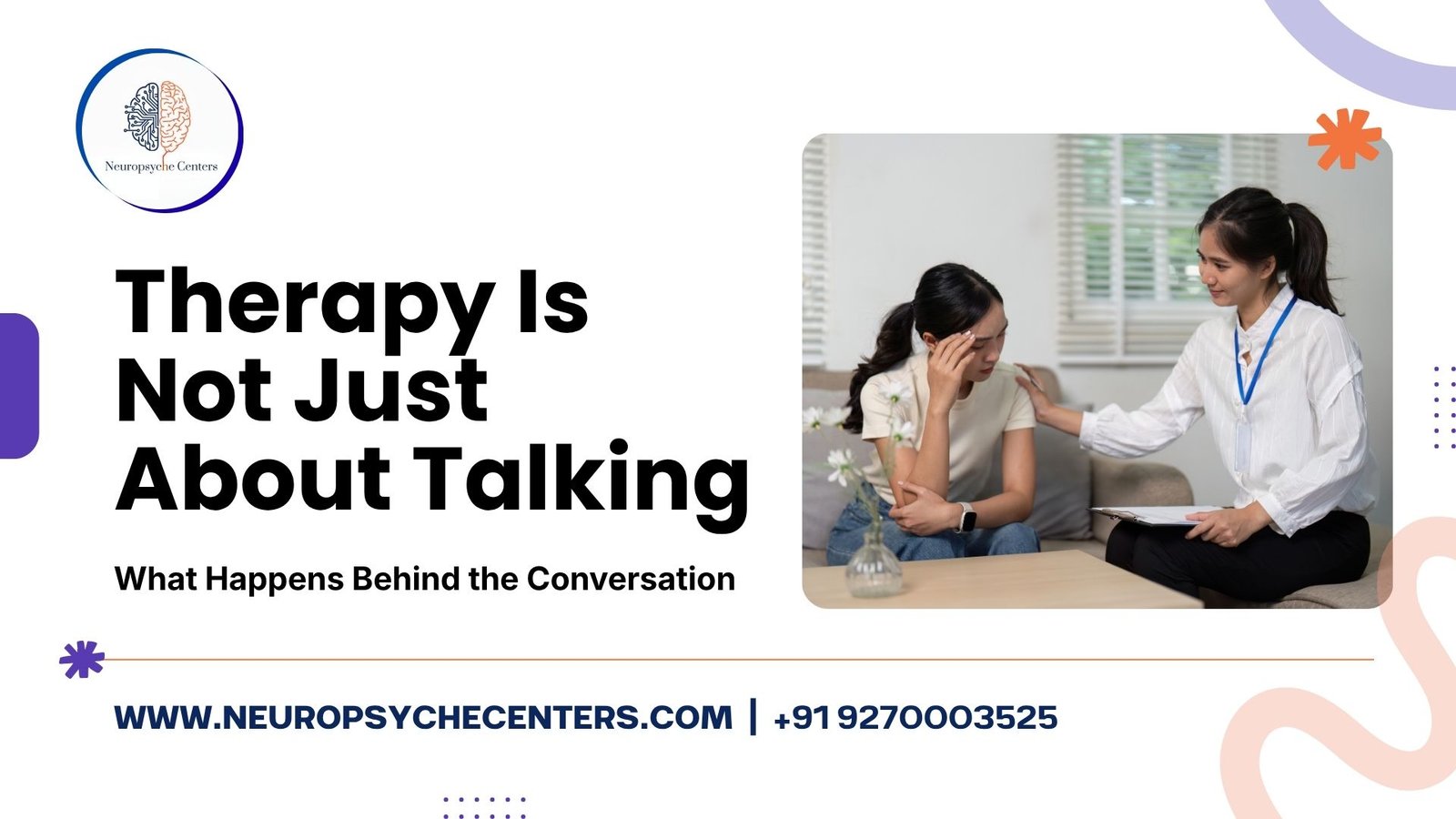
Therapy Is Not Just About Talking: What Happens Behind the Conversation
There is a familiar image of therapy: two people sitting across from each other, one speaking and the other listening. From the outside, it can look almost ordinary, a conversation taking place in a quiet room. But therapy is not an ordinary conversation. When someone says, “I’m fine,” a therapist may hear the tiredness hidden behind the words. When someone laughs while describing something painful, that laughter may carry a story of its own. When a person falls silent, the silence is not necessarily empty. It may be where the most difficult emotions are sitting. Therapy begins with talking, but it moves much deeper than conversation. It is about noticing what is said, what is avoided, what keeps repeating, and what a person may not yet have the language to express. In many ways, therapy is like turning on a light in a room that someone has been navigating in the dark, not to judge what is inside but to finally see it clearly.
1. The Words Are Only the Surface
People rarely walk into therapy carrying a neatly organised explanation of what is happening inside them. They may say, “I am stressed,” “I get angry very quickly,” “I overthink everything,” or simply, “I don’t know what’s wrong with me.” These sentences are often the visible tip of something much larger. A therapist may gently explore when the feeling appears, what triggers it, how the person responds to it and what meaning they have attached to it. Someone who says they have “anger issues” may actually be carrying years of feeling unheard. Someone who constantly seeks reassurance may be living with a deep fear of uncertainty. Someone who appears highly independent may have learned early that depending on others feels unsafe. Therapy therefore looks beyond the label and towards the story underneath it. The therapist listens for patterns, not to catch the person contradicting themselves, but to understand the map of their emotional world. The goal is not to dissect every sentence, but to understand what the sentences are trying to tell us.
2. Between One Sentence and the Next, There Is a Story
Some of the most meaningful moments in therapy do not arrive as dramatic revelations. They can be incredibly small- a pause before answering a question, a change in tone, looking away while discussing a particular memory, becoming unusually quiet after mentioning a relationship, or repeatedly saying, “It doesn’t matter.” These moments can offer important clues about emotions that may be difficult to approach directly. Therapy creates space for those moments without forcing them open. A person may slowly begin recognising that the same pattern appears in different parts of life- at work, in friendships, in relationships, or even in the way they speak to themselves. They may discover that their reactions in the present are sometimes connected to experiences from the past, or that a thought they have accepted as truth is actually an old belief they have been carrying for years. This is where therapy becomes more than emotional release. It becomes a process of observation and understanding. Like looking at ripples on water and gradually noticing where the stone first entered, therapy helps connect the visible reaction with what may be happening underneath.
3. The Therapist Is Not There to Hand Out Answers
Another common expectation is that therapy is a place where someone comes with a problem and leaves with a solution. But human emotions rarely behave like equations with one correct answer. A therapist does not simply provide a list of instructions for how a person should live, react, forgive, leave, stay, change or move on. Instead, therapy can help a person develop the ability to understand their own experiences and make more intentional choices. This may involve recognising unhelpful thinking patterns, understanding emotional triggers, learning coping skills, improving communication, setting healthier boundaries, building emotional awareness or developing greater tolerance for uncomfortable feelings. Sometimes it involves learning a new skill, and sometimes it involves sitting with an emotion that has been avoided for years. The therapist becomes less like someone holding a ready-made answer and more like a guide holding a torch on an unfamiliar path. The person still walks the path. The therapist simply helps make the terrain easier to see.
4. The Session Ends. The Work Doesn’t.
Perhaps the most overlooked part of therapy is what happens after the conversation ends. The real impact may appear quietly in ordinary moments, someone notices their usual reaction beginning and chooses to pause, someone expresses a need instead of expecting another person to guess it, someone recognises an anxious thought without immediately believing it, someone catches themselves using the same harsh words towards themselves that they would never use with a friend. These moments may look insignificant from the outside, but they represent something important, the movement of therapy from the room into everyday life. Progress is not always a dramatic transformation. Sometimes it is a slightly longer pause before reacting, a little more understanding towards oneself, or the ability to tolerate a difficult feeling without immediately running from it. Therapy does not promise a life without difficult days. Instead, it can help a person build a different relationship with those difficult days. The conversation becomes practice, awareness becomes a skill, insight becomes action. And slowly, what was once discussed in a therapy room begins to influence how a person speaks, chooses, connects and lives outside it.
Final Thoughts
Therapy is often described as a place to “talk about your feelings.” Perhaps it would be more accurate to say that therapy gives feelings somewhere to go and gives a person the opportunity to understand where they came from, what they are trying to communicate and how they want to respond to them.
- Sometimes healing does not arrive as one life-changing conversation.
- Sometimes it looks like recognising a pattern you had never noticed before.
- Sometimes it sounds like saying something you have been afraid to say.
- Sometimes it is learning to sit with yourself without immediately trying to fix yourself.
- Sometimes, it is simply realizing that the story you have been telling yourself about who you are is not the only story available to you.
Therapy is not just about talking.
It is about what becomes visible when someone finally feels safe enough to speak and what they choose to do with that understanding afterwards.