








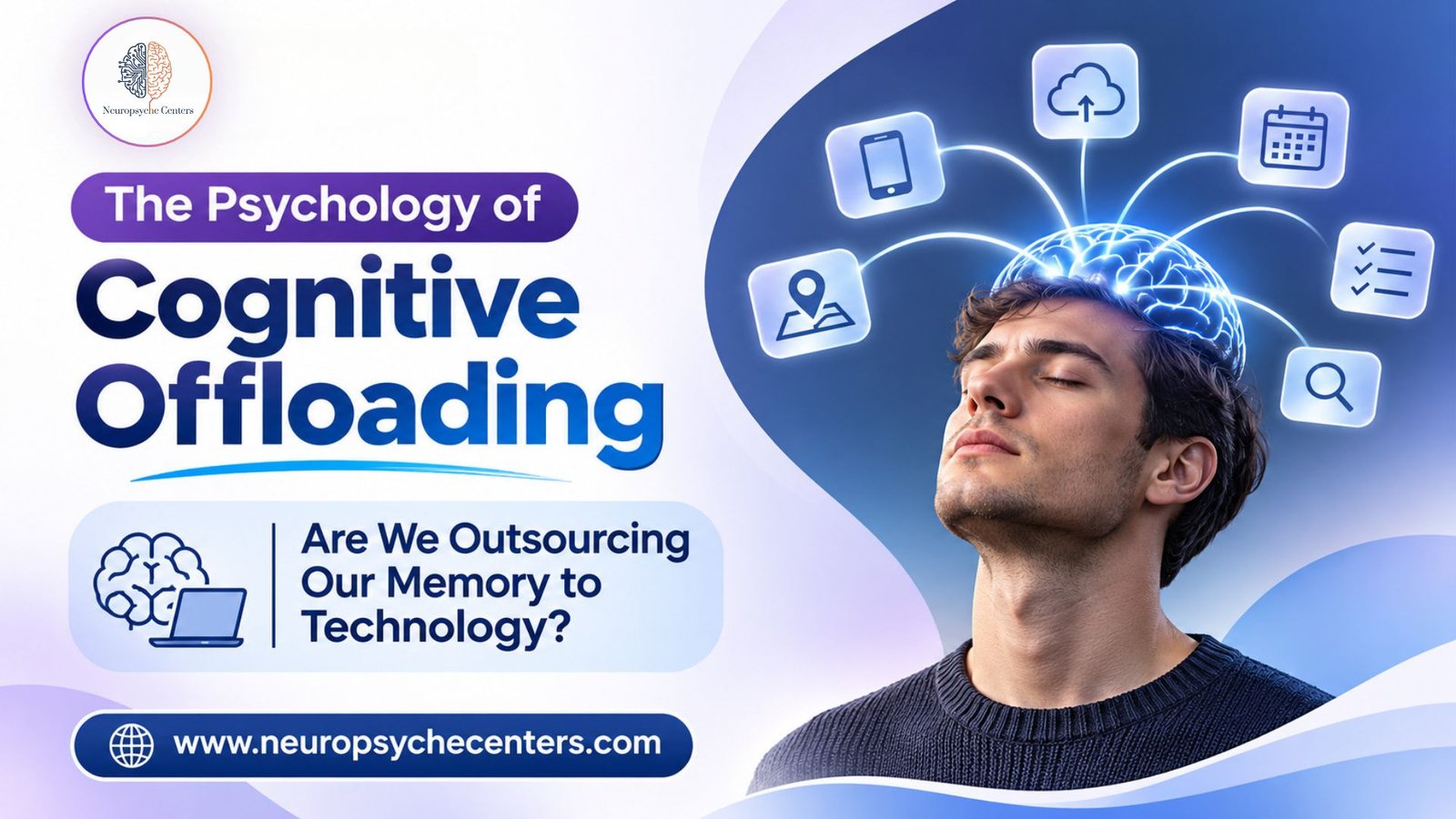
The Psychology of Cognitive Offloading: Are We Outsourcing Our Memory to Technology?
Imagine trying to remember a friend’s phone number, the directions to a familiar place, or even a shopping list.
A few years ago, you might have made an effort to remember these details. Today, you are more likely to save the number in your contacts, follow a navigation app, or add the items to a digital list. When you need the information, you simply retrieve it from your phone.
This everyday habit reflects a psychological process known as cognitive offloading. Technology has made information easier to store and access, but it also raises an interesting question: as our devices remember more for us, are we giving our own memory less opportunity to work?
What Is Cognitive Offloading?
Cognitive offloading refers to using external resources to reduce the mental effort required to complete a task. Instead of holding information in our minds, we transfer some of the mental work to something outside the brain.
For example, setting a reminder for an appointment means you do not have to continuously remember its date and time. Using a calculator reduces the need to perform calculations mentally. Similarly, saving notes, using calendars, bookmarking websites, and relying on GPS navigation are all forms of cognitive offloading.
Importantly, cognitive offloading is not a new behaviour. People have used notebooks, calendars, maps, and written lists for centuries. Technology has simply made these tools more accessible, immediate, and integrated into everyday life.
From a psychological perspective, this process is connected to distributed cognition—the idea that thinking does not always happen inside an individual’s brain alone. Our environment, tools, and other people can become part of how we process and manage information.
How Does Technology Influence Our Memory?
Human memory is not designed to retain every piece of information we encounter. It involves encoding, storage, and retrieval, and each process can be influenced by attention, repetition, meaning, and context.
Digital tools can change how we approach these processes.
One relevant concept is the Google Effect, also known as digital amnesia. Research by Betsy Sparrow and colleagues (2011) suggested that people may be less likely to remember information itself when they expect it to remain accessible online. Instead, they may remember where or how to find it.
For instance, someone may not remember the exact facts about a topic after reading them online, but may remember which website or search engine can provide those facts again.
This does not necessarily mean that memory is becoming weaker. It may indicate a shift in what we prioritise remembering. Rather than storing every detail, we sometimes remember the route to the information.
However, there is an important distinction between knowing where to find information and understanding it deeply. Quickly retrieving an answer does not always mean that we have processed, connected, or retained the information meaningfully.
What Happens to Attention and Cognitive Functioning?
Cognitive offloading can be helpful, but the way we use technology matters.
1. Reduced Mental Effort
External reminders and digital tools can free up working memory—the system responsible for temporarily holding and manipulating information.
For example, writing down several tasks can reduce the need to keep remembering them while completing other activities.
This can make complex tasks easier to manage. However, when we automatically depend on external tools for even simple information, we may miss opportunities to practise recalling and organising information independently.
2. Distraction and Divided Attention
Smartphones provide constant access to messages, notifications, and information. Even when we are not actively using them, the possibility of an incoming notification can sometimes interrupt concentration.
When attention repeatedly shifts between tasks, it becomes harder to process information deeply. Since attention plays an important role in memory formation, distracted learning may also affect how well information is retained.
3. Dependence on External Reminders
Imagine someone who relies entirely on phone reminders for appointments, daily tasks, and deadlines.
These reminders can be useful, but if the person does not develop any additional planning habits, they may struggle when their device is unavailable or notifications are missed.
The concern is not using reminders; it is relying on them without developing a reliable system for managing responsibilities.
4. Less Active Engagement with Information
There is a difference between reading something and actively thinking about it.
When we immediately search for an answer, we may skip the process of trying to recall, compare, or reason through the information ourselves.
Active mental engagement, including retrieval practice, helps strengthen learning. Therefore, always choosing the quickest digital answer may sometimes reduce opportunities for deeper processing.
Is Cognitive Offloading Good or Bad?
It is neither inherently good nor bad. Its impact depends on what we outsource and what we continue to practise.
Using a calendar to remember appointments can reduce unnecessary mental load and allow us to focus on more meaningful activities. Using GPS can make unfamiliar journeys easier. Digital notes can help organise complex information.
At the same time, relying on technology for every small decision or piece of information may encourage passive habits.
The goal should not be to stop using technology. Instead, it is to use it in ways that support our cognitive abilities rather than replace every opportunity to exercise them.
How Can We Develop a Healthier Relationship with Digital Memory?
A few small changes can help maintain a balance between using technology and engaging our own memory.
- Practise recalling before searching: When you want to remember a fact, name, or concept, pause and try to retrieve it before opening a search engine.
- Use reminders strategically: Set reminders for important deadlines and appointments, but also develop a simple daily planning routine.
- Engage actively while learning: After reading an article or watching a video, close it and explain the main ideas in your own words.
- Reduce unnecessary notifications: Keep alerts for important communication and disable those that frequently interrupt concentration.
- Navigate familiar places occasionally without GPS: When appropriate and safe, try recalling familiar routes to practise spatial memory.
These practices are not about proving that we can function without technology. They are about maintaining an active role in our own thinking.
A Small Exercise: What Do You Outsource to Your Phone?
For one day, observe how often you use your smartphone to remember or retrieve information.
At the end of the day, reflect on these questions:
- How many times did I check my phone for information I could have tried to remember?
- Did I use reminders because the task was genuinely important, or simply out of habit?
- Did I search for answers immediately without first thinking about them?
- Which digital tools genuinely made my day easier?
- Is there one small activity in which I would like to rely more on my own memory?
There is no need to stop using these tools. The purpose is to become more aware of your habits and make intentional choices.
When Should You Seek Professional Guidance?
Occasionally forgetting information, misplacing things, or depending on reminders is common and does not automatically indicate a memory problem.
However, if memory difficulties are persistent, worsening, or beginning to interfere with work, studies, relationships, or everyday responsibilities, it is worth seeking professional guidance.
A psychologist can help explore whether difficulties are associated with attention, stress, sleep, emotional concerns, or other cognitive and behavioural factors. A psychiatrist or medical professional may assess possible medical or psychiatric contributors and recommend further evaluation when needed.
At Neuropsyche Centers, psychologists and psychiatrists can help individuals understand persistent concerns related to memory, attention, and cognitive functioning.
If you decide to consult a professional, share specific examples of what you have been forgetting, when the difficulties began, how frequently they occur, and whether they affect your daily routine. Mention any relevant changes in sleep, stress, medication, or health. This information can help guide an appropriate assessment.
The Bigger Picture: Technology Should Support, Not Replace, Our Thinking
Technology has changed how we remember, learn, and organise our lives. We no longer need to memorise every phone number, appointment, or piece of information, and that is not necessarily a problem.
The more important question is whether we are using technology consciously or allowing convenience to become automatic dependence.
Our devices can store information, remind us of responsibilities, and help us find answers. But understanding, reasoning, connecting ideas, and making meaningful decisions still require our active participation.
Perhaps the healthiest approach is not to remember everything ourselves, but to remain mentally engaged even when technology is doing some of the remembering for us.