








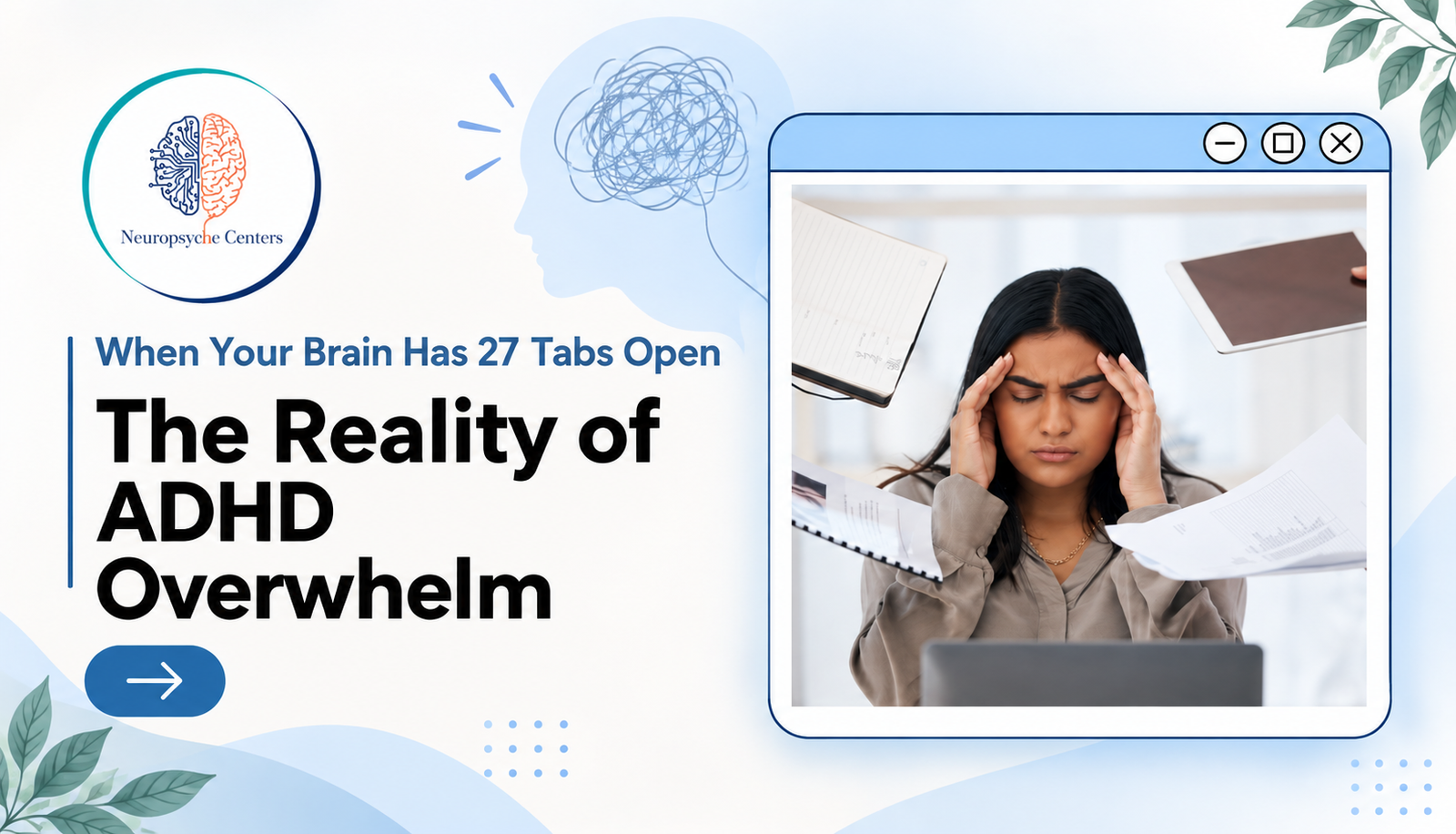
When Your Brain Has 27 Tabs Open: The Reality of ADHD Overwhelm
You know the feeling.
You sit down to answer one email. Somewhere between typing the subject line and hitting send, your brain has already opened twelve other tabs did I pay that bill, I should start dinner, what was that text I forgot to reply to, my leg hurts, did I lock the car, why did I walk into this room again and the original email is now buried under all of it, blinking, unanswered, forgotten. This isn’t laziness. It isn’t a lack of willpower. It’s what an ADHD brain does, every single day.
The Tabs Are Always Open
Neurotypical brains can close a tab when they’re done with it. One thought finishes, it gets filed away, and the next one opens in its place. It’s linear. Sequential. Manageable. An ADHD brain doesn’t work that way. Tabs don’t close they just pile up, running in the background, quietly draining energy even when you’re not looking at them. By 3 pm, you’re not tired because you did twelve things. You’re tired because you were thinking about forty things while trying to do one.
This is why a “simple” task replying to a text, starting laundry, filling out a form can feel disproportionately exhausting. It was never simple. It was one visible task sitting on top of an invisible mountain of mental noise.
Why This Gets Misunderstood
From the outside, ADHD overwhelm often looks like:
“You’re just distracted.” No ! you’re managing more simultaneous input than most people process in a day.
“You need better time management.” Time management assumes the problem is scheduling. The real problem is that the brain can’t sequence it treats every tab as equally urgent, all at once.
“Just focus.” Focus isn’t the missing ingredient. Filtering is. An ADHD brain struggles to mute the tabs that don’t matter right now, not to concentrate in general.
This mismatch between what’s actually happening internally and what’s visible externally is exactly why so many people with ADHD grow up feeling “too much” or “not enough” too scattered, not disciplined enough, too sensitive, not trying hard enough. None of that is true. The tabs were just never visible to anyone but them.
What Overwhelm Actually Feels Like
Starting five things and finishing none, not from disinterest, but because attention kept getting hijacked
A racing sense of “I have so much to do” even while sitting still
Forgetting the task mid-task
Emotional flooding irritability, tears, or shutdown that seems to come from nowhere, but is really the nervous system hitting capacity
The paradox of needing rest and being unable to rest, because the tabs don’t stop just because the body sat down
This is not a character flaw. It’s a nervous system working overtime with no “close all tabs” button.
What Actually Helps
1. External brain, not internal willpower.
Write it down. All of it. Sticky notes, apps, voice memos anything that moves a tab out of your head and onto a surface reduces the cognitive load of holding it there.
2. One tab at a time, on purpose.
Body doubling, timers, or simply saying out loud “right now I am only doing this” can help the brain anchor to a single task instead of juggling all of them at once.
3. Build in recovery, not just productivity.
Rest isn’t a reward for finishing everything it’s what lets the nervous system actually close a few tabs. Downtime is maintenance, not laziness.
4. Compassion over correction.
The inner voice that says “why can’t you just get it together” adds another tab shame on top of everything else. Self-compassion doesn’t fix ADHD, but it stops overwhelm from compounding into anxiety and burnout.
5. Professional support.
A therapist who understands ADHD not just as a diagnosis, but as a lived, moment-to-moment experience can help build coping strategies that actually match how your brain works, instead of forcing it into a system designed for a different kind of mind.
The Real Truth
Having 27 tabs open isn’t a flaw in the system. It is the system a brain that’s wired for rich, fast, associative thinking, running in a world that mostly rewards linear, single-tasked focus. You don’t need to be “fixed.” You need tools, understanding, and sometimes, permission to close a few tabs without guilt.Because a mind that holds this much isn’t broken it’s just overdue for a browser restart.
If ADHD overwhelm is something you or someone you love struggles with daily, know that support exists and that understanding how your brain works is the first step toward working with it instead of against it.